
 18 views
How Does Marriage Counseling Work? A Detailed Guide to What It Is, When to Take It
Learn what marriage counseling is, when couples should consider it, how sessions are planned, what happens in the first session, how effective it is, and what to expect from the process.

Saima Islam
Assistant Clinical Psychologist
 4.95
4.95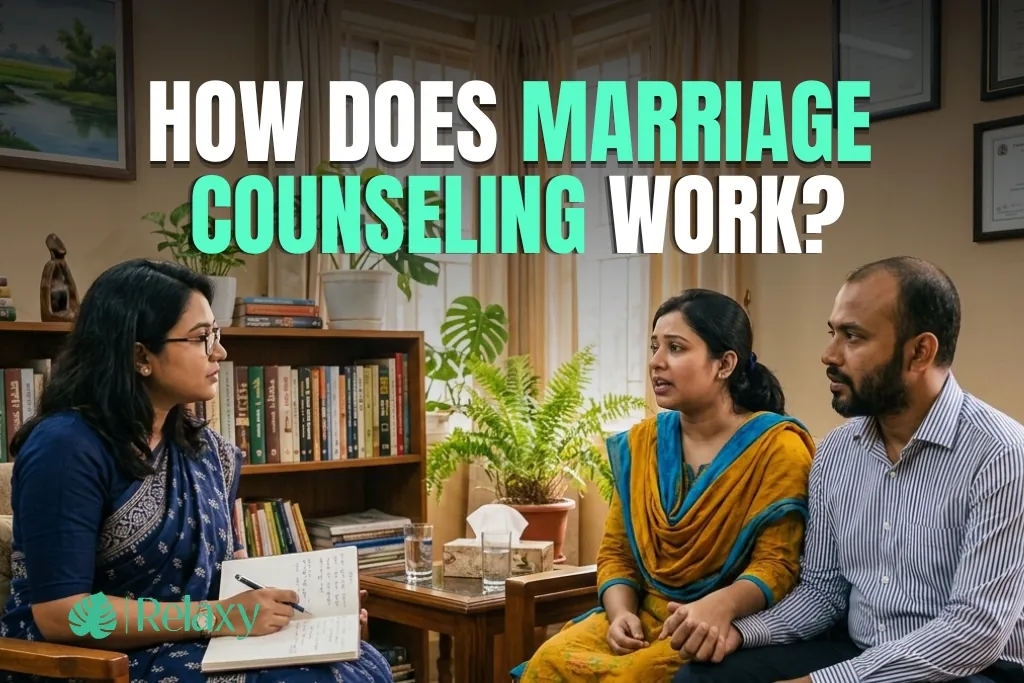
Key Takeaways
- Marriage counseling is a form of psychotherapy for couples, usually led by a trained mental health professional such as a marriage and family therapist.
- It can help with communication problems, emotional distance, trust issues, infidelity recovery, life stress, and repeated conflict cycles.
- The first session usually focuses on assessment, goals, and understanding the relationship pattern rather than fixing everything immediately.
- Sessions are often structured around goals, practice, reflection, and between-session exercises.
- Therapy is generally effective, but it works best when both partners are engaged and the therapist is trained in couples work.
- Counseling does not always save a marriage, but it can still help couples make healthier, clearer, and more respectful decisions.
How Does Marriage Counseling Work?
Many couples reach a point where they still care about each other, but talking feels harder than before. Small disagreements turn into long arguments. Old hurts keep coming back. One partner feels unheard, the other feels attacked. Sometimes the problem is not a lack of love, but a pattern of communication, stress, defensiveness, distance, or unresolved pain that the couple can no longer untangle on their own. In those situations, marriage counseling can offer a structured and professional space to understand what is happening and what can be changed. Couple therapy is not only for “broken” relationships; it is often used to improve communication, repair trust, and help partners make thoughtful decisions about their relationship.
What Is Marriage Counseling?
Marriage counseling, also called couples therapy or relationship counseling, is a form of psychotherapy in which a trained mental health professional works with two partners to understand relationship difficulties and improve how they relate to each other. Marriage and family therapists are specifically trained to view problems in the context of interaction patterns and relationships, not only as individual problems. In the United States, licensed marriage and family therapists typically have at least a master’s degree and supervised clinical experience, and they are trained to work with individuals, couples, and families.
Marriage counseling is not about declaring who is right or wrong. It is also not simply a place to “vent.” Good couples therapy usually focuses on patterns: how arguments start, what makes them escalate, what each person is feeling underneath the surface, how trust is affected, and how both partners can respond in healthier ways. Some services describe couple therapy as a safe and caring environment where both people can talk openly, explore the relationship, and find ways to connect that feel right for both of them.
Who Is Marriage Counseling For?
Marriage counseling is not only for legally married couples. It can also help long-term partners, engaged couples, cohabiting couples, and in many services, any adult partnership regardless of sexual orientation or whether they live together. Some people also seek premarital counseling to discuss expectations, roles, finances, family planning, conflict style, and communication before marriage. (Tavistock and Portman)
When Should a Couple Consider Marriage Counseling?
Couples do not have to wait until the relationship is at a breaking point. In fact, counseling often works better when partners come in before resentment becomes deeply fixed. Common reasons to seek marriage counseling include repeated communication problems, emotional distance, trust issues, constant arguments, unresolved hurt after betrayal, parenting stress, financial tension, intimacy difficulties, and major life transitions. Professional sources also note that therapy can be useful when couples feel stuck in the same fight again and again, or when they want help making careful decisions about whether and how to move forward. (rdash.nhs.uk)
It may be time to seek help when:
- the same conflict keeps repeating without resolution
- conversations quickly become blame, silence, or shutdown
- one or both partners feel lonely inside the relationship
- trust has been damaged
- stress from work, family, infertility, illness, or parenting is affecting the marriage
- the relationship feels more exhausting than supportive
- one or both partners want to improve the marriage but do not know how to begin. (rdash.nhs.uk)
What Problems Can Marriage Counseling Help With?
Marriage counseling can help with a wide range of issues, including poor communication, conflict cycles, emotional withdrawal, jealousy, infidelity recovery, intimacy concerns, family boundary problems, parenting disagreements, and mental health concerns affecting the relationship. Some NHS services explicitly note that couple therapy may help with relationship distress connected to depression, anxiety, life events, trauma, and sexual problems, depending on the service and therapist’s scope. NICE also recommends considering behavioral couples therapy for depression when relationship problems may be contributing to the depression or affecting recovery. (talkingtherapies.hwhct.nhs.uk)
How Does Marriage Counseling Actually Work?
At its core, marriage counseling works through a combination of assessment, structured conversation, emotional insight, skill-building, and repeated practice. The therapist helps the couple identify the negative interaction patterns they get stuck in, understand the emotions and assumptions driving those patterns, and then develop better ways of communicating and responding. Psychotherapy more broadly works by helping people understand troubling thoughts, emotions, and behaviors, and by teaching new ways of coping and relating. In couple therapy, this happens in a shared relational space rather than only inside one individual. (Mayo Clinic)
A therapist may help a couple:
- slow down heated conversations
- notice triggers and escalation points
- identify deeper feelings beneath anger, such as fear, shame, loneliness, or disappointment
- practice listening without interrupting
- use less blame and more clear emotional expression
- rebuild trust through consistency and accountability
- create healthier boundaries and routines
- decide on specific goals for change. (rdash.nhs.uk)
What Happens in the First Marriage Counseling Session?
The first session is usually focused on understanding the couple’s situation rather than solving everything immediately. In psychotherapy generally, the first session often involves gathering information about the concerns, emotional and physical background, relationship history, and goals for therapy. It may take a few sessions for the therapist to fully understand the situation and recommend the best course of action. The first session is also a chance for the couple to see whether they feel comfortable with the therapist. (Mayo Clinic)
In marriage counseling, the first session often includes:
- why the couple came now
- what each partner sees as the main issue
- how long the problem has been going on
- what happens during conflict
- what each person hopes will change
- whether there are concerns about trust, intimacy, parenting, family involvement, or emotional safety
- confidentiality and its limits
- how sessions may be structured moving forward. (NHS Barnsley Talking Therapies)
Some therapists may meet both partners together from the start. Others may include individual check-in sessions early in the process as part of the assessment. APA materials on couple assessment note that early evaluation may require understanding each individual, the relationship, and the surrounding context in order to grasp the distress accurately. (APA)
How Are Marriage Counseling Sessions Planned?
Marriage counseling is usually not random conversation. Sessions are often planned around goals, patterns, and specific relationship difficulties. The therapist and couple may agree on treatment goals such as improving communication, reducing conflict escalation, rebuilding trust, increasing emotional closeness, repairing intimacy, or making decisions about the future of the relationship. Therapy in general tends to work best when there is agreement about goals and tasks, which APA highlights as part of effective psychotherapy. (APA)
A planned marriage counseling process may include:
- Assessment phase – understanding history, current problems, strengths, and stressors
- Goal-setting phase – agreeing on what improvement would look like
- Intervention phase – learning and practicing new tools
- Review phase – tracking progress and adjusting the plan
- Closure or maintenance phase – consolidating what was learned and planning how to handle future stress. (Mayo Clinic)
How Long Does Marriage Counseling Usually Last?
There is no single fixed number of sessions for every couple. The length depends on the severity of the problem, how motivated both partners are, the therapy model being used, and whether there are additional issues such as trauma, depression, or infidelity recovery. Some services provide time-limited counseling and discuss the number of sessions at or near the first session. NHS counseling pages note that sessions are often around 50 minutes and that the number of sessions can be discussed early on. AAMFT materials also report that marital or couples therapy, on average, may require fewer sessions than some individual treatment formats, though this is an average and not a rule for every case. (NHS Barnsley Talking Therapies)
Premarital counseling is often shorter and more structured; AAMFT notes that premarital work often involves roughly 5 to 7 sessions centered on questionnaires, goal-setting, and practical discussions. By contrast, couples working through betrayal, chronic conflict, or complex mental health issues may need longer treatment. (aamft.org)
What Happens During a Typical Session?
A typical session often includes checking in on what happened since the last session, reviewing difficult moments, identifying the interaction pattern, and practicing new ways of communicating. In psychotherapy generally, therapists may ask clients to discuss troubling experiences and emotions, and some therapies include exercises or homework between sessions so that the couple can apply what they are learning in daily life. Mayo Clinic notes that therapists may assign specific activities or practice outside sessions, and CBT-focused therapy commonly uses homework tied to treatment goals. (Mayo Clinic)
In a marriage counseling session, the therapist may:
- help each partner speak without interruption
- reflect back what each partner is saying
- point out blame, defensiveness, or withdrawal patterns
- guide a more productive version of a difficult conversation
- teach emotional regulation or communication tools
- assign a between-session exercise such as a check-in routine, listening practice, or conflict script. (rdash.nhs.uk)
What Therapy Approaches Are Commonly Used in Marriage Counseling?
Marriage counseling can involve different evidence-based approaches. Some therapists use Emotionally Focused Couple Therapy (EFT/EFCT), which focuses on attachment, emotional patterns, and repairing connection. APA materials describe EFCT as an evidence- and attachment-based couple therapy designed to help distressed couples by changing dysfunctional interactive cycles. Other therapists may use behavioral couples therapy, cognitive-behavioral approaches, integrative couple therapy, or systems-based work depending on the couple’s needs and the therapist’s training. NICE specifically mentions behavioral couples therapy in some contexts, such as depression with relationship difficulties. (APA)
Is Marriage Counseling Confidential?
Marriage counseling is generally confidential, but confidentiality is not unlimited. Services typically explain the limits of confidentiality in the first session, such as concerns about risk of harm, safeguarding, or legal requirements. NHS counseling resources specifically note that confidentiality and its limits are discussed early in therapy. (NHS Barnsley Talking Therapies)
Couples should also ask the therapist how individual disclosures are handled if one partner shares something privately. Different therapists and models may have different policies, so this is worth clarifying at the start.
Is Marriage Counseling Effective?
In general, psychotherapy is recognized by APA as effective and cost-effective, and this includes couple and family formats. AAMFT also points to a strong evidence base for couple and family interventions across a range of mental and behavioral health conditions, based on decade reviews in the Journal of Marital and Family Therapy. That does not mean therapy works perfectly for every couple, but it does mean there is substantial research support for couple-based interventions when used appropriately. (APA)
Marriage counseling tends to be more effective when:
- both partners attend consistently
- both are willing to look at patterns, not only blame the other person
- there is at least some motivation to improve the relationship
- the therapist is trained in couples work
- the problems are addressed before contempt and chronic shutdown become deeply entrenched. (NHS Barnsley Talking Therapies)
It can also be effective after very painful events. For example, Mayo Clinic notes that marriage counseling can help after an affair by putting the event into perspective, identifying issues that contributed, teaching ways to rebuild and strengthen the relationship, and helping avoid divorce if that is the shared goal. AAMFT also notes that many relationships survive infidelity and that some become stronger after couples therapy, though outcomes vary and depend greatly on the couple’s commitment and context. (Mayo Clinic)
Does Marriage Counseling Always Save a Marriage?
No. Marriage counseling is not a guarantee that every marriage will stay together. A good therapist is not there to force the couple to remain together at all costs. Some NHS couple therapy services explicitly say that their role is not to “fix” people or keep couples together no matter what, but to help them understand what is happening and support thoughtful choices about the relationship. (rdash.nhs.uk)
That means therapy may help a couple repair and reconnect, or it may help them arrive at a clearer, more respectful decision about separation. In either case, counseling can still be valuable because it reduces confusion, improves communication, and can help people move forward with more understanding and less damage.
Why Does Marriage Counseling Sometimes Not Work?
Marriage counseling may help less when one partner is unwilling to engage, when sessions are attended only to prove a point, when there is ongoing deception, or when one or both people expect the therapist to simply take sides. Therapy can also stall if the therapist is not adequately trained in couples work, or if the relationship involves ongoing abuse or coercive control that requires a safety-focused response rather than ordinary couple work. The fact that progress may take several sessions is normal; Mayo Clinic notes that it can take a few sessions for a therapist to understand the concerns and determine the best course. (Mayo Clinic)
What Should Couples Do to Get the Most Out of Counseling?
Couples usually benefit more when they come in with honesty, patience, and realistic expectations. Psychotherapy sources emphasize that therapy requires effort and regular attendance, and that completing suggested practices between sessions can strengthen results. (NHS Barnsley Talking Therapies)
Helpful habits include:
- attending regularly
- being honest, even when it feels uncomfortable
- listening with the goal of understanding
- trying homework or between-session exercises
- not expecting immediate resolution after one session
- focusing on patterns, not only the latest fight
- giving the process time while also checking whether the therapist feels like a good fit. (Mayo Clinic)
Who Should Provide Marriage Counseling?
Because couples work is specialized, it is wise to look for a licensed therapist with training in couples or marriage and family therapy. Mayo Clinic notes that a marriage and family therapist is trained in family and individual therapy and can help with family and relationship problems; in the U.S., they usually hold at least a master’s degree, with licensing requirements that vary by state. (Mayo Clinic)
When choosing a therapist, it is reasonable to ask:
- What training do you have in couples therapy?
- What approach do you use?
- How do you handle individual disclosures?
- How do you structure sessions?
- What do you do if one partner wants to leave and the other wants to stay?
An Important Note About Safety
Marriage counseling is meant for relationship distress, communication problems, trust repair, and decision-making. But when there is ongoing violence, intimidation, coercive control, or fear for safety, the first priority is safety, not standard couple communication work. In those situations, a different level of intervention may be necessary. Relationship distress and abuse are not the same thing, and they should not be treated as the same.
Marriage counseling works by giving couples a structured, guided, and professionally supported way to understand their relationship patterns and change them. It helps partners slow down conflict, express themselves more clearly, listen more effectively, rebuild trust, and make thoughtful decisions about their future. The first session usually focuses on understanding the problem, early sessions build a shared map of the relationship, and later sessions often focus on skill-building, emotional repair, and practical change. Research and professional guidance support the use of couple therapy for many kinds of relationship distress, though results depend on the couple’s goals, the severity of the problems, and the quality of engagement in therapy.
Marriage counseling is not a sign that a relationship has failed. Very often, it is a sign that the relationship matters enough for both people to stop repeating the same pain and start trying a healthier way forward.
Download Relaxy App
Book a Counseling Session
FAQ
Is marriage counseling only for married couples?
No. Many therapists also work with engaged couples, long-term partners, and other adult couples.
How many sessions does marriage counseling take?
It varies. Some services are time-limited, and some issues require longer work. Sessions are often around 50 minutes, and the number of sessions is commonly discussed early in treatment.
Will the therapist take sides?
A trained couples therapist usually focuses on the pattern and the relationship dynamic, not on choosing a winner.
Can marriage counseling help after infidelity?
Yes, it can help some couples understand what happened, rebuild trust, and decide whether they want to repair the relationship.
What if one partner is unsure about continuing the marriage?
Counseling can still help clarify feelings, reduce chaos, and support more respectful decision-making.
This article is for general education and is not a diagnosis or a substitute for individual medical advice.
Last updated: October 9, 2026
Did you find this article helpful?
Saima Islam
Assistant Clinical Psychologist
4.95Warm and empathetic psychologist specializing in CBT and DBT for depression, anxiety, trauma, and relationship challenges
